

Motherhood, Laid Bare on the Surgery Floor
I had lunch with a doctor the other week. She's a consultant now, with a young family, recently back from maternity leave. Navigating all the challenges of being the ‘new consultant’, returning to work after a year away, juggling childcare, holidays, caring for an elderly parent. She talked about how much she had looked forward to getting to this stage of her career and yet the guilt, the lack of support from her colleagues, the feeling that you can't do it all, that something had to give was overwhelming.
What started out as a “how are you doing?” kind of conversation suddenly hit me really hard.
I was back in 2007 before I even knew it.
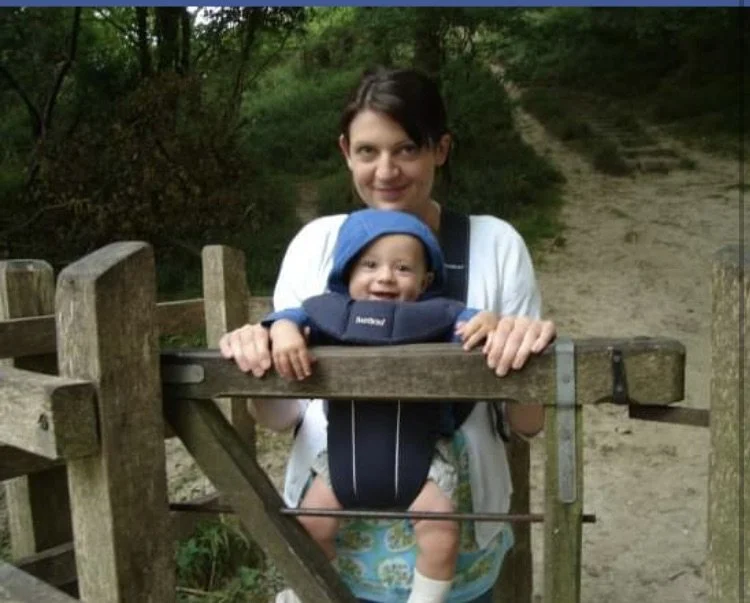
2007 with my son Joseph
I had just qualified as a GP. Seven months of maternity leave, and then back to work. My son still so little. I was wearing the professional version of myself like clothes that didn't quite fit anymore — finding the right words, the right expression, the right response. “I'm managing. I'm fine. This is fine.”
I remember so vividly the sense of dread and anxious anticipation before a working day. The logistics of getting a baby to nursery and yourself to a surgery on time, every single morning, with nothing to spare. I remember watching the clock towards the end of evening surgery, hoping that the last few patients would be straightforward. Hoping I wouldn't run late. Hoping I could get through everything and leave on time to collect him.
Because there was very little room for things not going to plan. You can't know how long a patient will need, or what they might disclose once the consultation begins. You can't simply cut a consultation short because the nursery is closing. Emergencies happen, surgeries run late. Admin tasks pile up. And so I would sit there, trying to be fully present with the person in front of me while a part of me was already thinking about the clock, the nursery, my baby waiting to be collected, and what would happen if I couldn't get there on time. There was this constant sense of being pulled in two directions, with a feeling of very little control over either.
One especially busy day, will forever stay with me. I rushed out of evening surgery to collect my son before the nursery closed at six, knowing that I would have to go back and finish off. Sitting him on the surgery floor with whatever I could find to keep him occupied while I completed the calls, the notes, the stuff that didn't end just because the working day did.
And I remember the senior partner walking in. He didn't shout. He didn't need to. He just slowly scanned the scene — me, my son, the floor and told me I wasn't managing my workload effectively. That I needed to rethink things.
I carried that for a long time. The shame of being found out. Of not being enough. Of the gap between who I was supposed to be in that room and who I actually was.
Looking back now, 19 years later, all I want to do is find that woman and hold her. She was doing everything. Everything. She was showing up to a system that had no language for what she was carrying, no structure to hold it, no curiosity about what it costs to return to a demanding clinical role while your body and your identity are still in the process of reorganising themselves. She was not failing. She was surviving something that was never designed with her in mind.
The systemic lack of compassion - from the culture to the individuals I worked with — is still astounding. And yet I know through listening to hundreds of other women doctors’ experience, that sadly it isn't unusual. I know it's not even close to the worst of it. This is the water we swim in. That's what makes it so insidious. The shame lands on the individual woman. The system stays intact.
There is something about the return from maternity leave that I think we don't talk about honestly enough. It isn't just logistical - though God knows the logistics are brutal. It's a threshold. You left as one version of yourself and you're back as someone who has been changed at a cellular level, and yet the institution is waiting for the old version. The one who doesn't have a child to care for . The one who doesn't need anything. The one who says everything is fine.
The performance of fine is exhausting in ordinary circumstances. After having a baby, it can feel unsurvivable. And underneath it, so often: shame. The feeling that you should be able to do this. That other women manage. That wanting support - needing it, asking for it - is evidence of some fundamental inadequacy.
It isn't of course. It never was. But I didn’t believe it, or know where to find it.

Coaching outdoors in nature - time and space to talk about what really matters…
This is why I do the work I do. Not just for the big moments — the maternity returns, the burnout, the breaking points. But for the smaller, quieter moments of navigating this life. The daily friction of being a woman in medicine. The hard edges. The moments when you wonder if it's just you, and it isn't, it never is, but you're so isolated you can't feel that.
I want there to be spaces where women doctors don't have to perform fine. Where the real conversation can happen — over lunch, or by a river, or in a room full of women who already understand the particular weight of this work and this life.
Because when I sat across from that doctor this week, and she started to talk about the reality of what she was carrying, I saw something shift in her face. The relief of being heard. Of someone saying: yes. I know. Me too. The system is broken, not you.