Tending the Flame: On Holding Space with Integrity
A reflection on safety, intention, and what it really takes to gather doctors in circle
In my work with doctors, I hear, with some regularity, stories of people who have been hurt in spaces that were meant to be supportive.
I am one of those people.
I have left a reiki session feeling emotionally bruised, my nervous system on high alert, having been opened up and then left without any real containment. A writing group that drew on participants’ experiences and emotions, without consent, as material for content. Groups where the purpose, boundaries and confidentiality have been woolly or non-existent. Each time, I left feeling raw, exposed, and, if I am honest, shaken. What had been marketed as healing, as nourishment, as care for my wellbeing, became the very opposite.
There is a growing trend for spaces labelled as safe. On social media, in professional networks, across the wellness landscape, the language of psychological safety, of holding space, of healing, is everywhere. I see it constantly. But let’s be clear, a space is not made safe simply by naming it as such. Safety is not a brand. It is not a candle and a carefully chosen playlist. It requires real care, genuine experience, professional training, and an understanding of trauma and group dynamics. Even then, and I say this with humility, I will not always get it right. What separates a responsibly held space from a harmful one is not perfection, but intention, preparation, and the willingness to hold clear boundaries with both gentleness and conviction.
I think about a woman I spoke with recently, a doctor whose words were used in a way that left her feeling humiliated and misunderstood. It took years before she was willing to sit in a group space again. A recently qualified doctor who had saved up and spent a significant amount on a retreat, that looked beautiful online, only to find it hollow at its centre. The space, it turned out, was more vehicle for content creation, than container for connection. She told me she didn’t feel safe to share anything and left early, upset, resentful and with a lasting feeling of having been seen by no one.
So if you have ever hesitated before joining one of my circles, I want you to know: that hesitation makes sense. It is wise. And it is precisely why I take this work as seriously as I do. As doctors we are expected and trained to know, to hold, to carry. We work within a culture that rarely makes room for uncertainty, for sitting with difficulty, or for admitting I am struggling without that meaning something has gone fundamentally wrong. And so, often without realising it, we become expert at holding everything alone. By the time many of us arrive at a circle, we are, more often than not, exhausted by the weight of it.
What a circle offers is almost the opposite of that world. There is no agenda to resolve, no problem to solve, no correct answer to reach. What there is, and this is the part that genuinely resists easy description, is the experience of being listened to without being fixed. Of having your sadness received as sadness. Your anger as anger. Your uncertainty met without analysis or advice. Something shifts in a room when a person is truly witnessed. I have watched it happen many times. It never stops being remarkable.
“What first drew me to Florescence Women’s Circle was the idea of a powerful space where women can fully express themselves. A place where feelings are shared, heard, understood, acknowledged, learned from, and appreciated — without bias or judgement. That felt both rare and deeply needed.
I didn’t have real reservations before coming, though I wondered whether I would be able to fully relax and open up. Very quickly, that uncertainty disappeared.
What I perhaps didn’t expect was the level of thought and care behind every detail. Alison brings such presence and attentiveness to how the circle is created and held, which makes the experience feel both intentional and effortless.”
What shapes my circles
When I hold space, whether online, around a fire, in a room, or in the natural world, the following principles shape everything I do.
A clear and honest invitation
Circle is not therapy. It is not a performance, or a workshop, or a networking event dressed in softer language. It is a shared space for reflection, for listening, and for human connection. From my first invitation, I am honest about what kind of space this is, what might feel tender within it, and what will always remain a matter of choice. You will know what you are walking into, because clarity is where a sense of safety begins.
Strong, compassionate boundaries
Boundaries are not barriers. They are containers, and a circle without one is not a circle, it is simply a room. Before we begin, we make a set of clear agreements together: about confidentiality, about how we speak and listen, about the right to pass, about what stays within the space. These agreements are revisited each time we meet. They are what allow people to relax into genuine trust. Every difficulty I have encountered in group work has, at its root, come from boundaries that were unclear or unenforced. Holding them, gently but without apology, is one of the most important acts of care I can offer.
Non-hierarchy in practice
In a circle, no one sits above another. Seniority, specialty, background, the many ways we are positioned differently within medicine, these things do not disappear of course, when we gather, but they become less important than what we share. I hold the structure, the time, the shape of the gathering, but I do not sit in the role of expert. I sit alongside. My work is to tend the space: to listen without agenda, to hold the edges, to notice when a pause is needed, to welcome what arrives without trying to direct it. The wisdom is in the group, not in me. That is something I believe genuinely, not as a form of false modesty, but because I have seen it borne out, again and again, in the circles I have held.
Integrity over aesthetics
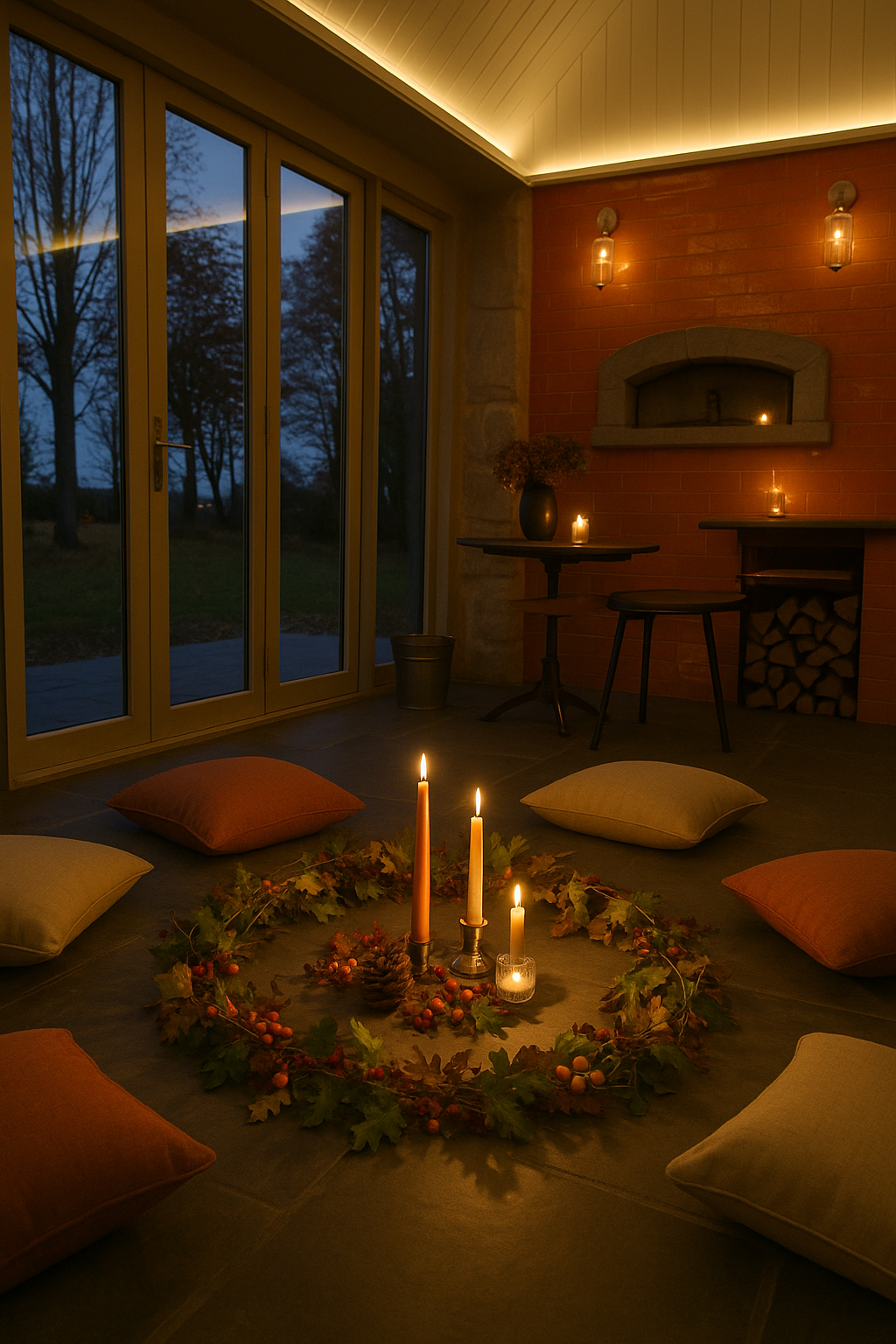
I care about beauty. I love a candlelit table, a vase of wildflowers, the warmth of natural textures, the ceremony of settling into a space together. But beauty in my circles exists to support presence and ease, not to perform a version of wellness, and not to create content. I have attended events where the host was visibly preoccupied with the image being created rather than the people in the room. I have felt, in those spaces, invisible and if I’m honest, annoyed. Ultimately, my attention and the environment itself communicate something simple yet profoundly important: you are here, and that matters.
There is no expectation to perform ‘calm’, or show insight, or any particular version of togetherness. The most alive circles I have held have been the ones where people felt entirely free to arrive as they were.
My role and responsibilities
When I hold a circle, I am not the centre of it. My role is to serve the group, to create the conditions for honest conversation, genuine reflection, and human connection. And I am also conscious that I must be nourished by the work. I can only hold space well if I have been held myself, if I continue my own reflective practice, my own supervision, my own ongoing learning. I design each circle in a way that sustains me too, where beauty, rest, and reciprocity flow in both directions.

What can you expect?
The physical experience of a circle matters more than people anticipate. The location and setting: whether we are gathered in a room held close by nature, around a fire, or meeting online, the conditions we each create around ourselves are part of the circle too. The way a room is arranged, so that every face is visible and no one sits behind another, does something to the nervous system before a word is spoken. The energy and atmosphere of the space, the details placed carefully with love, the food and drink that may accompany the circle, all of it chosen to nourish, these things are all part of the experience too. Even online, I ask that we find a place that is uninterrupted, that we attend to the lighting, that we bring something of the natural world into our eyeline if we can. There is a quality of attention that becomes possible when you are not performing to the front of a room, not waiting to be assessed, not competing to be heard. Many doctors have told me they have not sat like that, truly still, truly equal, since they were children.
I think of my Florescence Sister Circles for women doctors. The ritual of settling in together, each person lighting a candle, the small ceremony of beginning, together. The sounds of the natural world outside, birdsong, wind, water. Inside, a different quality of stillness. Everyone arrives carrying their own stuff, inside their own lives, their week, their own emotional load. And yet there is also, almost immediately, something that connects us to each other before many words have been spoken, a shared recognition, a knowing. In a circle, both can be true at once: you are held in your own particular experience, and held by what you share. The magic of it lives in what people allow themselves to feel together, in the simple and profound fact of not being alone with it.
You will not be pressured to speak. You will be invited, never compelled. You may sit in silence for the entire time if that is what you need. You may say something you have never said aloud before. You may cry, or laugh, or simply breathe differently for an hour. All of it will be received with an open heart.
Your presence, exactly as you are, will be enough.
“It was the most wonderful evening. You created something really beautiful and I can’t wait to come to the next circle. I have been imagining and yearning for something like this and it was just magic”
Why circle, why now, why for doctors?
We are not designed to carry things alone. And yet the culture of medicine has, for generations, asked exactly that. The expectation of self-sufficiency, of professional composure, of managing difficulty privately. They are the price of a system that has not, historically, known how to care well for the people within it.
I truly believe circle is the most nourishing, intensely human antidote for that.
We heal and grow by connecting with others, in community. Through giving language to what we have been holding. Through being witnessed without being judged. Through remembering, in the company of others, who we were before the system shaped us, and who we might yet become.
This is what I am on a mission to bring to the profession, to the people working within the NHS that I care so deeply about. Not a perfect space, because no space is. But a carefully held one, shaped by years of experience, ongoing learning, and a genuine, abiding care for the doctors who come.